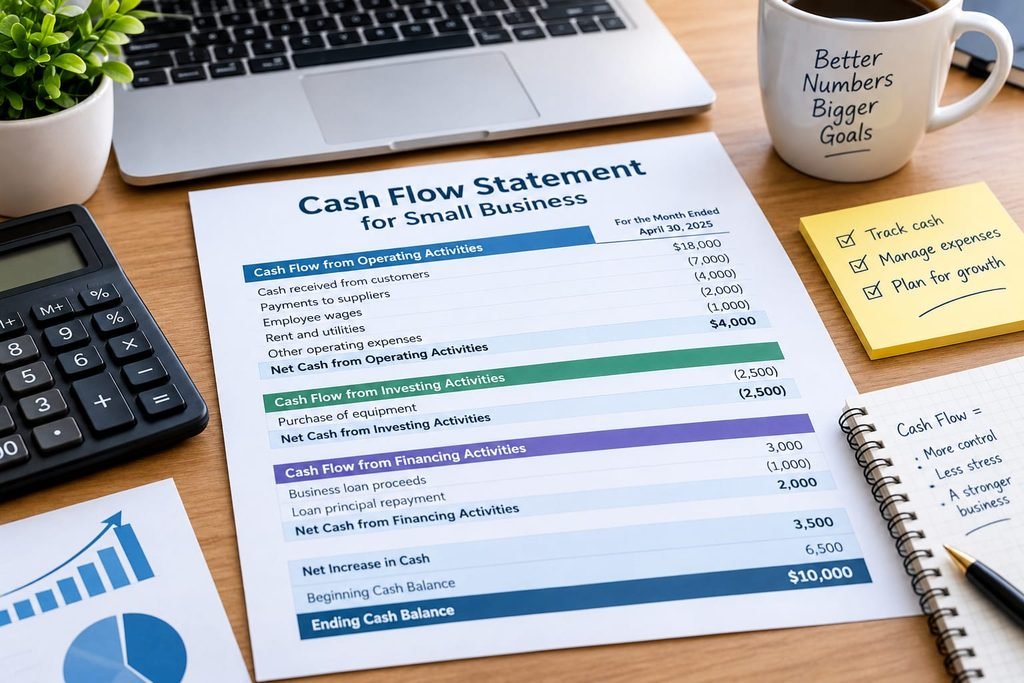
A cash flow statement for small business helps owners understand how money moves into and out of their company during a specific period. It shows where cash comes from, how it is spent, and whether the business has enough cash available to meet its financial obligations.
Even a profitable business can experience cash shortages if customers pay late, expenses increase, or loan payments become difficult to manage. Understanding your cash flow statement can help you identify these problems early and make better financial decisions.
In this guide, you will learn what a cash flow statement is, how to read its three main sections, how to calculate net cash flow, and how to use this financial report to manage your business more effectively.
What Is a Cash Flow Statement?
A cash flow statement is a financial report that summarizes the cash a business receives and pays out during a specific period, such as a month, quarter, or year.
It helps business owners understand whether their company generates enough cash to pay suppliers, cover operating expenses, repay loans, and support future growth.
Unlike an income statement, which generally records revenue when it is earned and expenses when they are incurred under the accrual method, a cash flow statement focuses on cash movements.
For example, a business may make a $5,000 sale in October but receive payment from the customer in November. Under accrual accounting, the revenue may be recorded in October. However, the cash will not appear as a receipt until the payment is collected.
This difference explains why a business can report a profit while still having difficulty paying its bills.
The U.S. Small Business Administration provides guidance on managing business finances, including the importance of bookkeeping and understanding financial reports. You can explore its official resources in the SBA business management guide.
Why Is a Cash Flow Statement Important for Small Businesses?
Cash flow affects almost every part of a small business. Owners need available cash to operate their companies, pay employees, purchase inventory, and respond to unexpected expenses.
A cash flow statement provides several important benefits.
1. Helps You Monitor Available Cash
The statement helps you understand whether your business is generating cash or using more cash than it receives.
Reviewing cash movements regularly can help you identify potential shortages before they become serious problems.
2. Helps You Plan Payments
Small businesses often have regular financial obligations, including rent, payroll, utilities, supplier invoices, insurance, and loan payments.
Understanding your cash flow can help you plan when to make payments and whether you need to keep additional cash available.
3. Supports Better Business Decisions
Before hiring employees, purchasing equipment, opening another location, or increasing inventory, business owners should consider the effect of these decisions on available cash.
A cash flow statement provides useful information for evaluating whether the business can afford these commitments.
4. Helps Identify Cash Flow Problems
If cash continues to decrease over several reporting periods, you may need to investigate the reasons.
Possible causes include slow customer payments, excessive operating expenses, large inventory purchases, or substantial debt repayments.
5. Helps Prepare for Financing
Lenders may review financial statements and cash flow projections when evaluating a business loan application.
A clear understanding of your cash flow can help you explain how your business generates cash and how it expects to meet future financial obligations.
The Three Main Sections of a Cash Flow Statement
A standard cash flow statement divides cash movements into three categories:
- Operating activities
- Investing activities
- Financing activities
Understanding these sections makes the report easier to interpret.
1. Cash Flow from Operating Activities
Operating activities include cash received and paid through the normal operations of the business.
Examples include:
- Cash collected from customers.
- Payments to suppliers.
- Employee wages and salaries.
- Rent and utility payments.
- Insurance payments.
- Other operating expenses.
Positive operating cash flow generally means the business is generating more cash from its core operations than it is spending on those activities during the period.
Negative operating cash flow means operating activities used more cash than they generated.
A negative result does not always indicate that a business is failing. A new company, for example, may experience temporary negative operating cash flow while building its customer base. However, persistent negative operating cash flow deserves careful investigation.
2. Cash Flow from Investing Activities
Investing activities generally involve purchasing or selling long-term assets and certain investments.
Examples include:
- Buying business equipment.
- Purchasing machinery.
- Buying qualifying long-term assets.
- Selling business equipment.
- Selling certain investments.
For example, if a small business purchases equipment for $4,000, the payment generally appears as an investing cash outflow.
Negative investing cash flow may indicate that a business is investing in equipment or other assets to support future operations. It should be evaluated in context rather than automatically treated as a problem.
3. Cash Flow from Financing Activities
Financing activities generally involve transactions that change the company’s borrowings or owners’ capital.
Examples may include:
- Receiving proceeds from a business loan.
- Repaying loan principal.
- Receiving capital contributions from owners.
- Issuing shares, where applicable.
- Paying dividends, where applicable.
For example, receiving a $10,000 business loan generally increases financing cash flow. Repaying $2,000 of loan principal generally reduces financing cash flow.
Loan interest is classified according to the applicable accounting framework and reporting policy, so it should not automatically be treated as a financing activity in every situation.
How to Read a Cash Flow Statement Step by Step
Reading a cash flow statement becomes easier when you follow a consistent process.
Step 1: Check the Reporting Period
Start by identifying the period covered by the report.
A monthly statement helps you understand short-term cash movements, while quarterly and annual statements provide a broader view of financial performance.
Compare statements covering similar periods whenever possible.
Step 2: Review Operating Cash Flow
Look at the cash generated or used by normal business activities.
Ask yourself:
- Is the business collecting payments from customers on time?
- Are operating expenses increasing?
- Is the business paying suppliers before collecting customer payments?
- Is operating cash flow improving or declining?
Operating cash flow is particularly important because it shows how the company’s regular activities affect its cash position.
Step 3: Review Investing Activities
Check whether the business purchased or sold significant assets during the period.
Large investing outflows may be reasonable if they support business growth. However, you should consider whether the company has enough cash remaining to cover its regular obligations.
Step 4: Review Financing Activities
Identify cash received from loans, owner contributions, and other financing transactions.
Also review loan repayments and other financing outflows.
A business that relies heavily on new borrowing to cover everyday operating costs may need to examine its underlying cash flow.
Step 5: Calculate the Net Change in Cash
Combine the net cash flows from operating, investing, and financing activities.
The formula is:
Net Change in Cash = Operating Cash Flow + Investing Cash Flow + Financing Cash Flow
If operating activities generate $8,000, investing activities use $3,000, and financing activities use $1,000, the net change in cash is:
$8,000 – $3,000 – $1,000 = $4,000
The business has generated a net increase in cash of $4,000 during the period.
Step 6: Check Beginning and Ending Cash
The beginning cash balance is the amount of cash available at the start of the period.
The ending cash balance is calculated by adding the net change in cash to the beginning cash balance, subject to the statement’s reporting scope and any required adjustments.
For example:
Beginning Cash: $12,000
Net Increase in Cash: $4,000
Ending Cash: $16,000
Review the ending balance alongside bank statements and other cash records to ensure that the reported figures are reasonab.
Cash Flow Statement Example for a Small Business
Consider a small business that sells office supplies. The following simplified example shows its cash movements for one month.
Operating Activities
| Item | Amount |
|---|---|
| Cash collected from customers | $18,000 |
| Payments to suppliers | -$7,000 |
| Employee wages | -$4,000 |
| Rent and utilities | -$2,000 |
| Other operating payments | -$1,000 |
| Net Cash from Operating Activities | $4,000 |
Investing Activities
| Item | Amount |
|---|---|
| Purchase of equipment | -$2,500 |
| Net Cash from Investing Activities | -$2,500 |
Financing Activities
| Item | Amount |
|---|---|
| Business loan proceeds | $3,000 |
| Loan principal repayment | -$1,000 |
| Net Cash from Financing Activities | $2,000 |
Summary
| Cash Flow Category | Amount |
|---|---|
| Operating Activities | $4,000 |
| Investing Activities | -$2,500 |
| Financing Activities | $2,000 |
| Net Increase in Cash | $3,500 |
| Beginning Cash Balance | $6,500 |
| Ending Cash Balance | $10,000 |
In this example, the business generated $4,000 from operating activities. After purchasing equipment and accounting for financing transactions, its cash increased by $3,500.
The ending cash balance was $10,000.
This is a simplified illustration. Actual cash flow statements may contain additional categories and adjustments depending on the business and the accounting framework used.
What Is the Difference Between Cash Flow and Profit?
Cash flow and profit are related, but they measure different things.
Profit generally represents revenue minus expenses over a reporting period. Cash flow measures cash received and paid during that period.
Consider a business that sells $10,000 worth of products on credit. If the products have associated expenses of $6,000, the sale may contribute $4,000 to profit before other expenses and adjustments.
However, if the customer has not paid yet, the business may not have received any cash from that sale.
The business may therefore report profit while having limited cash available.
Other factors that can cause differences between profit and cash flow include:
- Depreciation expense.
- Customer payments received after a sale.
- Supplier bills paid after expenses are recorded.
- Equipment purchases.
- Loan principal repayments.
- Owner contributions and withdrawals.
Understanding both profit and cash flow helps business owners evaluate performance and financial stability.
Cash Flow Statement vs. Income Statement vs. Balance Sheet
These three financial reports serve different purposes.
| Feature | Cash Flow Statement | Income Statement | Balance Sheet |
|---|---|---|---|
| Main purpose | Shows cash movements | Shows revenue, expenses, and profit or loss | Shows assets, liabilities, and equity |
| Reporting focus | Cash inflows and outflows | Financial performance | Financial position |
| Time period | Covers a period | Covers a period | Shows balances at a specific date |
| Useful for | Understanding liquidity | Evaluating profitability | Evaluating what the business owns and owes |
A cash flow statement helps you understand whether cash is available to meet obligations.
An income statement helps you understand whether the business earned a profit or incurred a loss.
A balance sheet shows the business’s assets, liabilities, and equity at a particular date.
Reviewing these reports together provides a more complete picture of business finances.
Common Cash Flow Problems and How to Address Them
Small businesses can experience cash flow problems even when sales are increasing.
Understanding the common causes can help you identify practical solutions.
1. Customers Pay Late
Late payments can reduce the cash available to cover expenses.
To address this problem:
- Send invoices promptly.
- Establish clear payment terms.
- Follow up on overdue invoices.
- Offer convenient payment methods.
- Review customer payment patterns.
Consistent invoicing and collection procedures can help reduce delays.
2. Operating Expenses Are Too High
Expenses such as rent, payroll, utilities, and subscriptions can consume a large portion of available cash.
Review expenses regularly and identify costs that can be reduced without damaging essential operations or customer service.
3. Inventory Uses Too Much Cash
Businesses that purchase inventory may have significant amounts of cash tied up in products that have not yet been sold.
Monitor sales patterns and stock levels to avoid unnecessary purchases.
4. Loan Payments Create Pressure
Debt repayments can reduce the cash available for daily operations.
Review the timing and amount of loan payments when preparing cash flow projections. If repayment difficulties arise, consider discussing available options with your lender before missing payments.
5. Sales Are Seasonal
Some businesses generate most of their revenue during particular months.
If your business experiences seasonal changes, estimate cash inflows and outflows for both busy and slow periods. Maintaining an appropriate cash reserve can help cover expenses when sales decline.
How to Improve Cash Flow in Your Small Business
Improving cash flow requires attention to both the timing of cash receipts and the timing of payments.
Prepare a Cash Flow Forecast
A cash flow forecast estimates the cash your business expects to receive and pay over a future period.
Include expected customer payments, supplier bills, payroll, rent, taxes, loan repayments, and planned purchases.
Review the forecast regularly and update it when actual results differ from expectations.
Collect Customer Payments Faster
Use clear payment terms and send invoices as soon as appropriate.
Monitor overdue balances and contact customers when payments are late.
If you offer credit to customers, establish a consistent process for reviewing and collecting outstanding invoices.
Control Business Expenses
Review recurring expenses and compare supplier prices when appropriate.
Prioritize essential costs and avoid committing to large new expenses without understanding their effect on available cash.
Maintain a Cash Reserve
Where possible, build a cash reserve to help cover unexpected costs or temporary declines in revenue.
The appropriate reserve depends on your operating expenses, business risks, seasonality, and access to financing.
Plan Major Purchases
Before purchasing equipment or expanding operations, estimate how the decision will affect cash over the coming months.
Consider the purchase price, ongoing maintenance, financing costs, and the expected benefits.
Review Cash Flow Regularly
Review cash flow at least monthly, and more frequently if your business has tight cash reserves or rapid changes in sales and expenses.
Regular monitoring helps you identify potential shortages and adjust your plans before problems become urgent.
How Often Should a Small Business Prepare a Cash Flow Statement?
Many small businesses prepare or review cash flow information monthly.
A monthly review can help owners compare cash movements, understand changes in available funds, and identify developing problems.
Businesses with frequent transactions or limited cash reserves may benefit from weekly cash flow monitoring and short-term forecasting.
A quarterly or annual review can provide a broader perspective on long-term financial trends.
The appropriate schedule depends on the size, complexity, and financial needs of the business.
Frequently Asked Questions
What is the main purpose of a cash flow statement?
Its main purpose is to show how cash enters and leaves a business during a specific period. It helps owners understand whether their company generates enough cash to cover operating expenses, debt payments, and other financial commitments.
Can a business be profitable but have negative cash flow?
Yes. A business may record revenue before customers pay, invest in equipment, purchase inventory, or make loan principal payments. These situations can cause cash flow to differ from reported profit.
What are the three sections of a cash flow statement?
The three main sections are operating activities, investing activities, and financing activities. Together, they explain the major sources and uses of cash during the reporting period.
What does positive operating cash flow mean?
Positive operating cash flow means the business received more cash from operating activities than it paid out for those activities during the period. It can be a useful sign, but owners should also review the consistency and sustainability of the cash generated.
What does negative cash flow mean?
Negative cash flow means cash outflows exceeded cash inflows during the period being measured. This may occur because of planned investments, seasonal changes, or operating difficulties. The cause and duration of the negative cash flow are important.
Can I prepare a cash flow statement in Excel?
Yes. A spreadsheet can help organize cash receipts, cash payments, and the three main cash flow categories. You should ensure that transactions are classified consistently and that the resulting balances agree with your accounting records.
Is a cash flow statement the same as a cash flow forecast?
No. A cash flow statement reports cash movements that have already occurred during a past period. A cash flow forecast estimates future cash receipts and payments.
Both reports are useful: the statement helps you understand what happened, while the forecast helps you plan for what may happen next.
Final Thoughts
A cash flow statement for small business is an important tool for understanding liquidity and managing financial obligations.
By reviewing operating, investing, and financing activities, you can identify where cash comes from, where it goes, and how your cash balance changes over time.
Remember that positive profit does not automatically mean that cash is available when you need it. Review your cash flow regularly, monitor customer payments, control expenses, and prepare forecasts to anticipate future needs.
With consistent cash flow management, small business owners can make more informed decisions, prepare for unexpected costs, and support sustainable business growth.