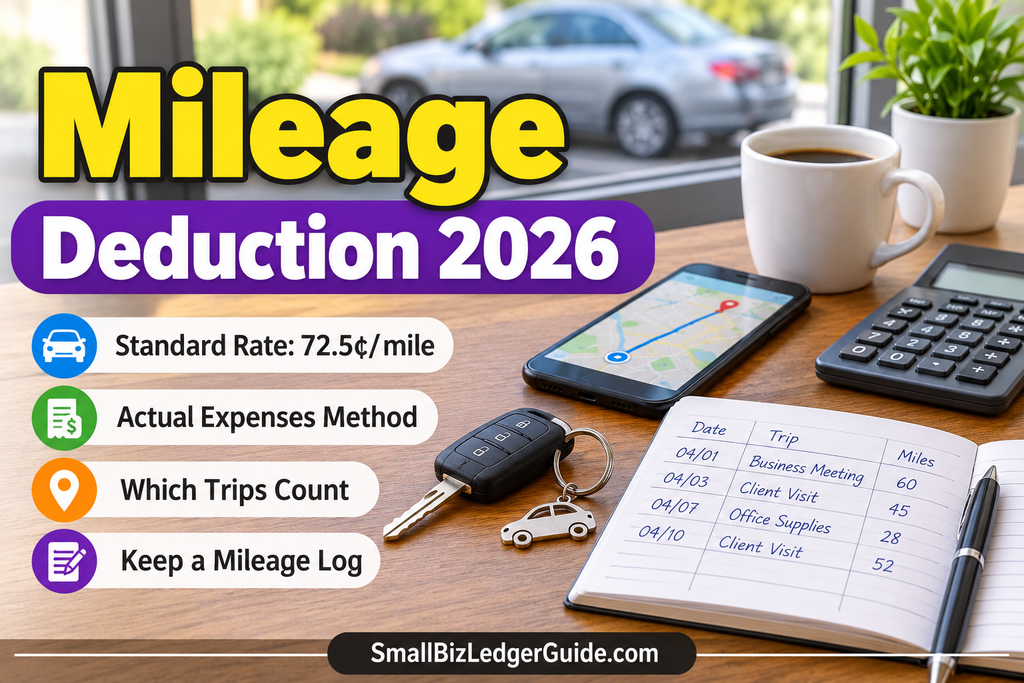
If you drive your own car for business, those miles can lower your taxes. Visiting clients, picking up supplies, and driving to a job site all add up over a year. The IRS gives self-employed people two ways to deduct the business use of a vehicle: the standard mileage rate or actual expenses.
This guide explains both methods, which trips count, and how to keep records that support your deduction.
Which Trips Count as Business Miles?
Business miles are miles you drive to carry out your business. Common examples include:
- Driving to meet a client or customer.
- Traveling between job sites or work locations.
- Running business errands, such as going to the bank or buying supplies.
- Driving to a temporary work location.
Commuting does not count. Driving between your home and your regular place of business is generally a personal commuting expense, even if you do business calls on the way. If your home is your principal place of business, trips from home to other business locations may qualify. The rules can depend on your situation, so check IRS Publication 463 if you are unsure.
Method 1: The 2026 Standard Mileage Rate (72.5 Cents per Mile)
The standard mileage rate is a set amount per business mile that covers the cost of owning and operating the vehicle. For 2026, the IRS set the business standard mileage rate at 72.5 cents per mile, effective January 1, 2026. The rate applies to cars, vans, pickups, and panel trucks, including electric and hybrid vehicles.
Example (hypothetical): You drive 6,000 business miles in 2026. Your deduction is 6,000 × $0.725 = $4,350.
Business parking fees and tolls can generally be deducted in addition to the standard mileage rate. The rate changes every year, so always use the rate for the year the miles were driven.
Method 2: Actual Expenses
Under the actual expense method, you add up the real costs of operating the vehicle and deduct the business-use percentage. Costs can include:
- Gas and oil
- Repairs, maintenance, and tires
- Insurance
- Registration and license fees
- Lease payments, or depreciation if you own the vehicle
Example (hypothetical): You drive 15,000 miles in total, and 6,000 are for business. Your business-use percentage is 40%. If your actual vehicle costs are $9,000 for the year, your deduction is 40% of $9,000, or $3,600. Vehicle depreciation has its own rules and limits, explained in our guide to depreciation for small business.
Choosing a Method: Rules to Know
- Owned vehicles: The IRS says that to use the standard mileage rate for a car you own, you must choose it in the first year the car is available for business use. In later years, you can choose either method.
- Leased vehicles: If you use the standard mileage rate for a leased vehicle, you must use it for the entire lease period, including renewals.
- Which is better? The standard rate is simpler and often works well for lower-cost cars driven many miles. Actual expenses may produce a larger deduction for vehicles with high operating costs. Comparing both in the first year helps you decide.
| Feature | Standard Mileage Rate | Actual Expenses |
|---|---|---|
| How it is figured | Business miles × IRS rate | Total costs × business-use percentage |
| Records needed | Mileage log, plus parking and tolls | Mileage log, plus every vehicle receipt |
| Depreciation | Built into the rate | Figured separately |
| Effort | Low | Higher |
How to Keep a Mileage Log
Whichever method you use, you need records that show your business miles. A good mileage log includes, for each business trip:
- The date
- Where you went
- The business purpose
- The miles driven
Also record your odometer reading at the start and end of the year so you can show total miles. Write trips down when they happen or use a mileage app. A log rebuilt from memory months later is much harder to defend. For more on what to keep, see small business tax recordkeeping.
Where to Claim the Deduction
Sole proprietors claim car and truck expenses on Schedule C and provide vehicle information on the form. A lower business profit also means less self-employment tax, which you can estimate with our self-employment tax calculator. Employees who are not reimbursed for driving generally cannot claim this deduction on their own return.
In your books, record vehicle costs in a dedicated expense account. Our guide to small business expenses explains how to organize them, and small business tax deductions covers other common write-offs.
Common Mileage Deduction Mistakes
- Counting commuting miles. Regular home-to-office driving is personal.
- Using both methods at once. If you use the standard rate, do not also deduct gas, repairs, or insurance for that vehicle.
- Using the wrong year’s rate. The IRS updates the rate each year.
- Keeping no log. Without records, the deduction is hard to support.
Frequently Asked Questions
What is the IRS mileage rate for 2026?
The business standard mileage rate for 2026 is 72.5 cents per mile.
Can I switch between the standard rate and actual expenses?
For a car you own, you must use the standard rate in the first year to be able to use it later. After that, you can choose either method each year. For a leased car, if you start with the standard rate, you must keep using it for the whole lease.
Do I need a mileage log if I use the standard rate?
Yes. The standard rate replaces tracking operating costs, but you still need to prove your business miles.
Conclusion
The business mileage deduction rewards good records. Know which trips count, choose the method that fits your vehicle, and log every business trip as it happens. Use the current year’s IRS rate, and talk to a tax professional if your vehicle use is complex.
Pingback: Small Business Tax Deductions: What You Can Deduct