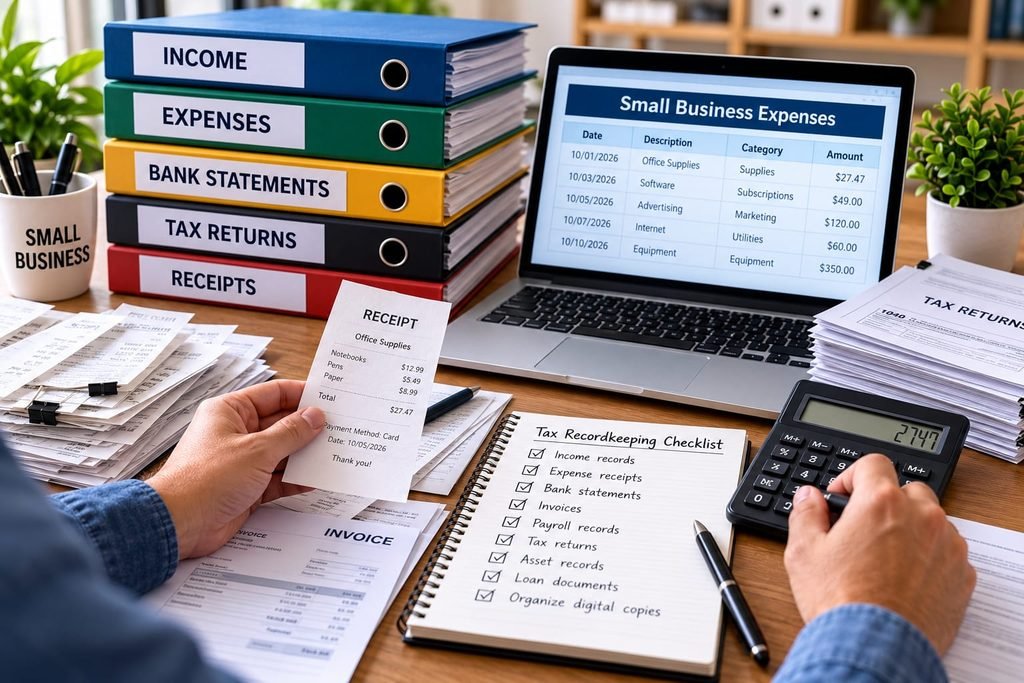
Keeping accurate tax records is an essential part of running a successful small business. Organized records help business owners track income, document expenses, prepare tax returns, and respond to questions from tax authorities. They can also make financial decisions easier throughout the year.a consistent small business tax recordkeeping routine helps you find receipts, verify expenses, and keep important financial documents organized throughout the year.
However, many small business owners are unsure which documents to keep, how long to retain them, and how to organize everything efficiently.
This guide explains small business tax recordkeeping, the documents you should maintain, and practical ways to build a recordkeeping system that works for your business.
What Is Small Business Tax Recordkeeping?
Small business tax recordkeeping is the process of collecting, organizing, and storing financial documents that support your business income, expenses, deductions, and tax filings.good small business tax recordkeeping also helps owners organize receipts, track deductible expenses, and prepare accurate tax returns.
These records provide evidence of your business transactions. They also help you prepare accurate financial statements and tax returns.
A good recordkeeping system should allow you to answer important questions, including:
- How much income did the business earn?
- What expenses did the business pay?
- Which transactions qualify as business expenses?
- How much money do customers still owe?
- Which bills remain unpaid?
- Can you support the information reported on your tax return?
The exact records you need depend on your business structure, activities, and applicable tax requirements.
Why Is Tax Recordkeeping Important for Small Businesses?
Accurate records help small business owners manage their finances and meet tax obligations.
1. Prepare Accurate Tax Returns
Your tax return should reflect your actual business income and allowable expenses. Organized records make it easier to calculate these amounts and reduce the risk of reporting errors.
2. Support Business Expenses and Deductions
Receipts, invoices, bank statements, and other documents can help support business expenses claimed on your tax return.
A transaction appearing on a bank statement does not always prove that the entire amount is deductible. Keep supporting documents that explain the business purpose of each expense.
3. Respond to Tax Questions
If the IRS asks questions about a tax return, organized documentation can help you explain and support the figures you reported.
4. Monitor Business Performance
Financial records help you understand revenue, expenses, outstanding invoices, and cash flow. This information can help you identify problems before they become serious.
5. Reduce Stress During Tax Season
When documents are organized throughout the year, preparing a tax return becomes more manageable. You spend less time searching for missing receipts and reconstructing old transactions.
For additional guidance, review the IRS resource for small businesses and self-employed taxpayers.
What Tax Records Should a Small Business Keep?
The following categories cover many of the records small businesses commonly need. Your exact requirements may vary depending on your industry and tax situation.
1. Income Records
Keep documents that show how much money your business earns and where that income comes from.
Examples include:
- Sales receipts
- Customer invoices
- Sales reports
- Payment processor statements
- Deposit records
- Business bank statements
- Records of cash sales
- Records of refunds and returned products
Your income records should make it possible to reconcile sales with the money received in your bank account or through payment processors.
If you accept cash, establish a consistent process for recording each sale and depositing business funds.
2. Expense Receipts and Invoices
Keep receipts and invoices for purchases made for business purposes.
Common examples include:
- Office supplies
- Business software
- Advertising and marketing
- Equipment and tools
- Business insurance
- Professional services
- Rent and utilities
- Shipping and delivery
- Repairs and maintenance
Each document should identify the transaction, amount, date, and business purpose when applicable.
For digital purchases, save electronic receipts and invoices in an organized location rather than relying only on email search.
3. Bank and Credit Card Statements
Business bank statements and credit card statements help you verify transactions and reconcile your accounts.
Keep statements for the accounts used in your business, along with supporting documents for significant transactions.
Whenever possible, separate business and personal finances. Mixing them makes it harder to identify deductible expenses and maintain reliable records.
A bank statement is useful evidence of a payment, but additional documentation may be necessary to explain what you purchased and why it was a business expense.
4. Payroll and Employee Records
If your business has employees, maintain the payroll and employment tax records required for your situation.
These may include:
- Employee wage records
- Payroll summaries
- Time and attendance records
- Payroll tax filings
- Records of tax deposits
- Employee tax forms
- Benefits and reimbursement records
Employment tax records can have specific retention requirements. Check the applicable IRS guidance and other relevant employment laws to determine how long each type of document must be kept.
5. Contractor and Vendor Records
If you pay independent contractors or other vendors, keep invoices, payment records, contracts, and any required tax forms.
These records help you verify what you paid and determine whether information reporting requirements apply.
Do not assume every contractor payment has the same reporting requirements. The rules can depend on the payment type, recipient, and current tax regulations.
6. Asset and Equipment Records
Keep documentation for business assets such as computers, machinery, vehicles, furniture, and other equipment.
Useful records include:
- Purchase invoices
- Purchase dates
- Payment evidence
- Asset descriptions
- Business-use information
- Sale or disposal records
- Depreciation schedules
These records can help determine the asset’s tax basis and support depreciation or other applicable tax treatment.
Do not automatically treat the full purchase price of every asset as an immediate business expense. Different rules may apply depending on the asset and your circumstances.
7. Loan and Financing Records
If your business borrows money, maintain loan agreements, lender statements, repayment schedules, and payment records.
Separate loan principal from interest in your bookkeeping. Loan proceeds generally are not treated the same as ordinary sales income, and principal repayments generally are not treated the same as deductible operating expenses.
Your records should clearly show how much you borrowed, how much you repaid, and how much interest you paid.
8. Tax Returns and Supporting Documents
Keep copies of filed federal, state, and local tax returns when applicable, together with documents that support the figures reported.
Depending on your business, these may include:
- Income calculations
- Expense summaries
- Deduction support
- Payroll tax filings
- Information returns
- Estimated tax payment confirmations
- Relevant tax notices and correspondence
Retaining prior returns can help you answer future questions and prepare subsequent filings.
9. Sales Tax and Other Business Tax Records
If your business collects sales tax or is subject to other business taxes, keep the records needed to support your calculations and filings.
Examples may include sales reports, tax collected, exemption certificates, filed returns, and payment confirmations.
Requirements differ by jurisdiction, so confirm the rules that apply to your business location and activities.
How Long Should You Keep Small Business Tax Records?
There is no single retention period that applies to every business record.
For U.S. federal tax purposes, the IRS generally explains that records should be kept as long as they may be needed to administer a tax law. The applicable period depends on the document and the circumstances.
For example, the IRS generally recommends keeping records for three years in many common situations. Longer periods can apply, including certain situations involving unreported income, specific claims, or employment taxes. Records connected with property may need to be retained until the limitations period expires for the year in which you dispose of the property.
These are general guidelines, not a universal rule for every document.
Before destroying old records:
- Identify the type of document.
- Check the applicable IRS retention guidance.
- Consider whether an amended return, audit, claim, or other tax matter affects the retention period.
- Check any state or local requirements.
- Keep records longer when another legal, contractual, or business requirement applies.
For the official guidance, read IRS Publication 583: Starting a Business and Keeping Records.
You can also review the IRS guidance on recordkeeping for small businesses.
How to Organize Your Small Business Tax Records
You do not need a complicated system to maintain useful records. The most important thing is to follow the same process consistently.aconsistent small business tax recordkeeping routine helps you find receipts, verify expenses, and keep important financial documents organized throughout the year.
Step 1: Separate Business and Personal Finances
Use a dedicated business bank account and, where appropriate, a business credit card.
This makes it easier to identify business transactions and reduces the time needed to review personal and business spending separately.
If a personal account has already been used for business transactions, document those transactions carefully and ask a qualified tax professional about any uncertainty.
Step 2: Create Clear Categories
Organize documents into categories such as:
- Income
- Operating expenses
- Payroll
- Contractors
- Equipment and assets
- Loans
- Taxes
- Bank statements
- Tax returns
Use categories that match your bookkeeping system so you can locate documents quickly.
Step 3: Save Digital Copies
Scan paper receipts or photograph them with a reliable recordkeeping app.
Use descriptive filenames that include the date, vendor, and transaction type when practical.
For example:
2026-10-05_Office-Supplies_Receipt.pdf
Store digital records in a secure location and maintain backups. Protect sensitive employee, customer, and financial information with appropriate access controls.
Check whether the relevant tax rules require particular original documents or additional information.
Step 4: Reconcile Your Accounts Regularly
Compare your accounting records with your bank and credit card statements at least monthly.
Investigate differences, missing transactions, duplicate entries, and unexplained charges.
Regular reconciliation can help identify errors before tax season.
Step 5: Review Records Every Month
Set aside time each month to confirm that invoices, receipts, statements, and payment records are complete.
A short monthly review is usually easier than trying to reconstruct an entire year of transactions at once.
Step 6: Back Up Important Documents
Keep a secure backup of important financial records.
Consider using a reputable cloud storage service or encrypted backup system. Make sure you can recover your documents if your computer is lost, damaged, or inaccessible.
Common Tax Recordkeeping Mistakes to Avoid
Even well-intentioned business owners can develop recordkeeping habits that create problems later.Consistent small business tax recordkeeping helps owners avoid missing receipts, maintain accurate financial records, and prepare for tax season.
Mixing Personal and Business Expenses
Combining personal and business transactions makes it harder to calculate business expenses accurately.
Keep transactions separate whenever possible and document any legitimate business transactions paid from a personal account.
Losing Receipts
Small purchases can add up over time. Save receipts promptly instead of waiting until the end of the month or year.
Recording Transactions Inconsistently
Use the same accounting categories and procedures throughout the year. Inconsistent records make financial reports less reliable.
Relying Only on Bank Statements
A statement shows that money moved, but it may not explain the purpose of the transaction. Keep invoices, receipts, contracts, or other relevant supporting documents.
Deleting Records Too Early
Do not destroy records simply because a tax return has been filed. Check the applicable retention period and consider whether the documents support assets, employment taxes, or other continuing obligations.
Waiting Until Tax Season
Leaving all recordkeeping until the end of the year increases the chance of missing documents and mistakes.
A regular bookkeeping routine helps keep the process manageable.
A Simple Small Business Tax Recordkeeping Checklist
Use this checklist to review your recordkeeping system.
- Record all business income.
- Save sales receipts and customer invoices.
- Keep receipts for business purchases.
- Store business bank and credit card statements.
- Maintain payroll and contractor records when applicable.
- Keep equipment and asset purchase documents.
- Save loan agreements and interest statements.
- Retain filed tax returns and supporting documents.
- Reconcile business accounts regularly.
- Organize digital records into clear folders.
- Back up important documents securely.
- Review record retention requirements before deleting files.
Review this checklist monthly and before preparing your tax return.
Frequently Asked Questions
What records should a small business keep for taxes?
Small businesses commonly need records of income, expenses, bank transactions, payroll, contractor payments, assets, loans, and filed tax returns. The exact requirements depend on the business and applicable tax rules.
Can I keep small business tax records digitally?
In many situations, electronic records can be used if they accurately preserve the required information and remain accessible. Maintain secure backups and check the rules that apply to your records.
How long should I keep business receipts?
The appropriate retention period depends on the tax rules and circumstances. For U.S. federal taxes, many records fall under a general three-year guideline, but longer periods may apply. Check the IRS guidance before disposing of receipts.
Do I need to keep bank statements if I use accounting software?
Yes, you should generally retain bank statements and other supporting financial documents even when using accounting software. They help verify transactions and reconcile your records.
What happens if I lose a business receipt?
Try to obtain a duplicate from the vendor or locate other reliable supporting documentation. Record the transaction accurately, but do not assume that a bank statement alone establishes every detail needed to support a deduction.
If the transaction is significant or the available evidence is incomplete, consult a qualified tax professional.
Should I keep tax returns permanently?
Keeping copies of important tax returns for an extended period can be useful, but the appropriate retention period depends on your circumstances and applicable requirements. Supporting documents may have different retention periods.
Conclusion
Small business tax recordkeeping does not have to be complicated. By maintaining income records, saving receipts, organizing bank statements, and reviewing transactions regularly, you can build a reliable financial recordkeeping system.
Start with a simple process, use consistent categories, and back up important documents. Review your retention requirements before destroying old records, especially those connected with tax returns, employees, and business assets.
Good recordkeeping can make tax preparation easier, help you understand your business finances, and give you better documentation when questions arise.
Pingback: Bank Reconciliation for Small Business: Step-by-Step Guide