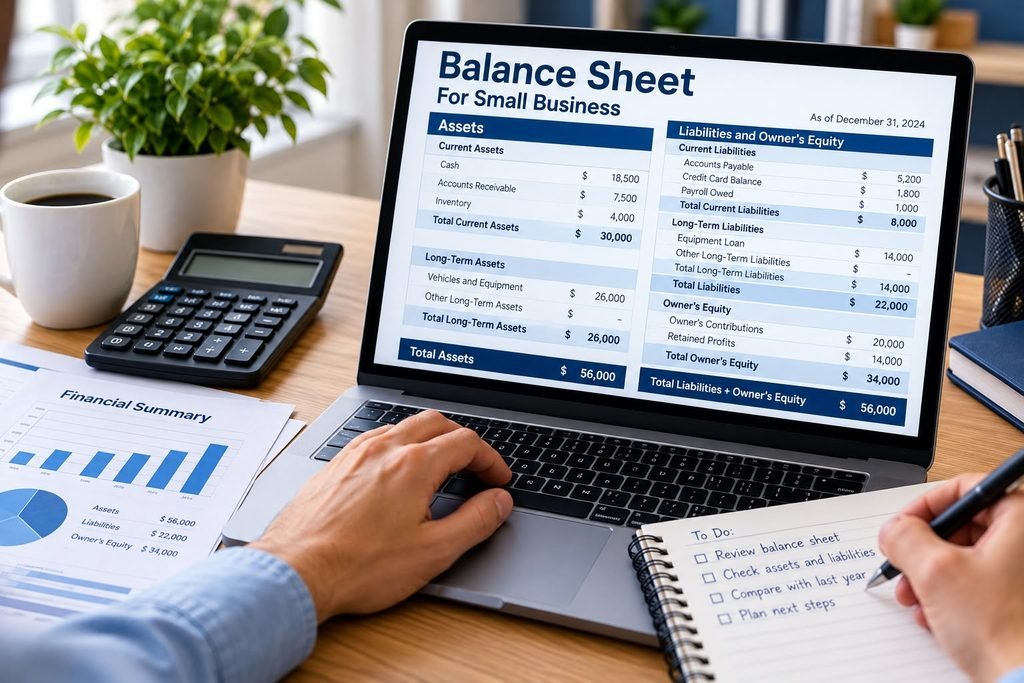
You may know how much money came into your business last month. But do you know what the business owns, what it owes, and what it’s worth on paper? A balance sheet for small business answers those questions in one page.
You don’t need to be an accountant to read one. This guide explains each part of the report, walks through a worked example where the numbers balance, and shows how to use the results to make better decisions.
What Is a Balance Sheet for Small Business?
A balance sheet is a financial statement that lists what your business owns (assets), what it owes (liabilities), and what is left for the owner (owner’s equity) on a specific date.
Think of it as a photograph. It shows your financial position on one day, such as December 31, not your results over a whole month or year.
Why a Balance Sheet Matters for Small Businesses
A balance sheet shows your financial health in a way a bank balance can’t. Here is what it helps you do:
- See whether your business owns more than it owes.
- Understand how much of the business is funded by debt and how much by the owner.
- Check whether you have enough short-term resources to cover upcoming bills.
- Share a clear financial picture with lenders, investors, or advisors.
- Track whether the business is growing in value over time.
What Does a Balance Sheet Include?
Every balance sheet has three main sections: assets, liabilities, and owner’s equity. Each is usually broken into smaller groups.
Assets
Assets are things your business owns that have value. They are usually split into current assets and long-term assets.
Current Assets
Current assets are cash and items likely to be turned into cash within about a year. Common examples:
- Cash in your bank accounts
- Money customers owe you, tracked in accounts receivable
- Inventory or supplies on hand
Assets are usually listed in order of how quickly they can be turned into cash.
Long-Term Assets
Long-term assets are items you expect to use for more than a year. Examples include vehicles, equipment, furniture, and buildings.
These are typically recorded at what you paid for them, reduced over time by depreciation, which spreads the cost of an asset across its useful life. Your accountant can help you handle depreciation correctly.
Liabilities
Liabilities are amounts your business owes to others. Like assets, they are divided into current and long-term.
Current Liabilities
Current liabilities are debts due within about a year. Examples:
- Unpaid vendor bills, tracked in accounts payable
- Credit card balances
- Payroll amounts owed but not yet paid
- The portion of a loan due in the next 12 months
Long-Term Liabilities
Long-term liabilities are debts due more than a year from now, such as the remaining balance on an equipment loan or a business loan with a multi-year term.
Owner’s Equity
Owner’s equity is the owner’s share of the business. It is what would remain if you subtracted all liabilities from all assets.
For a sole proprietorship, it typically includes the money the owner put into the business plus profits kept in the business, minus money the owner withdrew. Corporations call this section stockholders’ equity.
Equity changes over time. Profit increases it, and losses and owner withdrawals decrease it. You can see where profit comes from by reviewing your profit and loss statement.
The Balance Sheet Formula Explained
The balance sheet is built on one equation, called the accounting equation:
Assets = Liabilities + Owner’s Equity
The two sides must always balance, because everything a business owns was paid for in one of two ways: with borrowed money (liabilities) or with the owner’s money (equity).
For example, if you buy a $10,000 piece of equipment with $4,000 of your own cash and a $6,000 loan, assets rise by $10,000. The loan adds $6,000 to liabilities, and the $4,000 of your own funds counts as equity. Both sides total $10,000.
If your balance sheet doesn’t balance, something has been recorded incorrectly.
Balance Sheet Example for a Small Business
This is a hypothetical example for a small landscaping company operated as a sole proprietorship. The figures are made up to show how the calculations work.
Green Row Landscaping: Balance Sheet as of December 31
| Item | Amount |
|---|---|
| ASSETS | |
| Current assets | |
| Cash | $18,500 |
| Accounts receivable | $7,500 |
| Supplies inventory | $4,000 |
| Total current assets | $30,000 |
| Long-term assets | |
| Vehicles and equipment (net of depreciation) | $26,000 |
| Total long-term assets | $26,000 |
| TOTAL ASSETS | $56,000 |
| LIABILITIES | |
| Current liabilities | |
| Accounts payable | $5,200 |
| Credit card balance | $1,800 |
| Payroll owed | $1,000 |
| Total current liabilities | $8,000 |
| Long-term liabilities | |
| Equipment loan (due after 12 months) | $14,000 |
| Total long-term liabilities | $14,000 |
| TOTAL LIABILITIES | $22,000 |
| OWNER’S EQUITY | |
| Owner’s contributions | $20,000 |
| Retained profits (after owner withdrawals) | $14,000 |
| TOTAL OWNER’S EQUITY | $34,000 |
| TOTAL LIABILITIES + OWNER’S EQUITY | $56,000 |
How the numbers work:
- Current assets: $18,500 + $7,500 + $4,000 = $30,000
- Total assets: $30,000 + $26,000 = $56,000
- Current liabilities: $5,200 + $1,800 + $1,000 = $8,000
- Total liabilities: $8,000 + $14,000 = $22,000
- Owner’s equity: $20,000 + $14,000 = $34,000
- The equation balances: $22,000 + $34,000 = $56,000, which equals total assets
Another way to check equity: total assets minus total liabilities is $56,000 − $22,000 = $34,000.
How to Read a Balance Sheet
Read the report in sections rather than trying to take in every number at once.
Review Your Assets
Start with what the business owns. Check how much is in cash versus tied up in customer balances, inventory, or equipment.
In the example, $18,500 of the $56,000 in assets is cash. Another $7,500 is money customers still owe, which only helps if they pay on time.
Understand What Your Business Owes
Next, look at liabilities. Pay attention to how much is due soon (current liabilities) versus later (long-term liabilities).
In the example, $8,000 is due within a year, and the business has $30,000 in current assets to cover it. That is a comfortable position.
A simple way to measure this is the current ratio: current assets divided by current liabilities. Here, $30,000 ÷ $8,000 = 3.75. Another is working capital: current assets minus current liabilities, or $30,000 − $8,000 = $22,000.
Review Owner’s Equity
Equity shows how much of the business belongs to the owner. In the example, it is $34,000 of the $56,000 in total assets.
Rising equity usually means the business is building value. Falling equity can mean losses or large owner withdrawals.
Check Whether the Balance Sheet Balances
Confirm that total assets equal total liabilities plus owner’s equity. If they don’t match, look for missing transactions, wrong amounts, or items recorded in the wrong section.
Compare Balance Sheets Over Time
Because a balance sheet is a snapshot, one report tells you little on its own. Compare this year-end with last year-end, or this month with last month.
Suppose the same business had $28,000 in equity a year earlier. Equity rose by $6,000 to $34,000. Look at what changed: more cash, lower debt, or higher customer balances. Each tells a different story.
How to Create a Balance Sheet for a Small Business
You can build one with accounting software or a spreadsheet. The steps are the same either way.
Choose a Reporting Date
Pick the exact date you want to report, such as the last day of the month, quarter, or year. Every figure must reflect the situation on that date.
Gather Your Financial Records
Collect bank statements, loan statements, customer invoices, vendor bills, equipment purchase records, and credit card statements. Keeping a separate business bank account makes this step far easier, because business money isn’t mixed with personal money.
List Your Assets
Record the value of each asset as of your reporting date. Group them into current and long-term, and total each group.
List Your Liabilities
List every debt and amount owed as of the same date. Separate what is due within a year from what is due later, and total each group.
Calculate Owner’s Equity
Subtract total liabilities from total assets. The result is owner’s equity. Then check that it makes sense given what the owner contributed, withdrew, and earned.
Check the Final Totals
Confirm that total assets equal total liabilities plus owner’s equity. If they don’t, review your records for errors before you rely on the report.
Balance Sheet vs. Profit and Loss Statement
The two reports answer different questions.
- Balance sheet: What does the business own and owe on a specific date?
- Profit and loss statement: How much did the business earn and spend over a period?
They are connected. Net profit from the P&L flows into owner’s equity on the balance sheet. A business can be profitable but still carry heavy debt, which only the balance sheet shows.
Balance Sheet vs. Cash Flow Statement
A cash flow statement tracks money moving in and out of the business over a period. The balance sheet shows the cash you have on one date, along with everything else you own and owe.
The cash line on the balance sheet is a result of cash flow, not an explanation of it. To understand why your cash went up or down, look at your small business cash flow reports.
Current Assets vs. Current Liabilities
Comparing these two groups tells you whether you can cover your short-term obligations.
- Current assets are cash and things you expect to convert to cash within a year.
- Current liabilities are bills and debts due within the same period.
If current assets are much larger than current liabilities, you likely have room to pay bills on time. If current liabilities are larger, you may face a cash squeeze unless more money comes in soon. Keep in mind that not all current assets are equally easy to use. Cash is available now, but customer balances and inventory take time to collect or sell.
Common Balance Sheet Mistakes to Avoid
- Mixing personal and business items. Personal expenses or assets distort the report.
- Leaving out liabilities. Unpaid bills, credit cards, and payroll owed all belong on the report.
- Misclassifying current and long-term items. This can make your short-term position look better or worse than it is.
- Skipping reconciliation. If the cash figure doesn’t match your bank statement, the report can’t be trusted.
- Using the wrong date. Mixing figures from different dates breaks the snapshot.
- Ignoring depreciation. Equipment recorded at full cost forever overstates what the business owns.
- Forcing the totals to balance. If it doesn’t balance, find the error instead of adjusting a number to make it match.
How to Use a Balance Sheet to Make Better Business Decisions
Once you understand the report, it can guide real decisions:
- Before taking on debt: See how much you already owe and whether your current assets can support more.
- Managing cash: If customer balances are growing, consider tightening collection.
- Planning purchases: Check whether you can afford equipment without straining short-term finances.
- Applying for financing: Lenders often want to see a balance sheet, and knowing yours helps you prepare.
- Tracking growth: Watch whether equity is rising year over year.
How Often Should a Small Business Review Its Balance Sheet?
Most small businesses benefit from reviewing a balance sheet monthly, after the books for the month are reconciled. A quarterly review works for steadier businesses. At minimum, prepare one at the end of each year.
Review it more often when you are applying for a loan, making a major purchase, or dealing with tight cash.
Balance Sheet and Small Business Bookkeeping
A balance sheet is only as accurate as the records behind it. Consistent [small business bookkeeping] means every asset, bill, and payment is recorded and reconciled, so the report can be produced quickly and trusted.
The IRS offers a general resource on this topic: IRS Publication 583, Starting a Business and Keeping Records covers basic federal tax information for people starting a business, along with information on keeping records.
If you don’t want to prepare the report yourself, a small business accountant can build it, check it, and explain what it means for your business.
Frequently Asked Questions
What is a balance sheet for a small business?
It is a financial statement showing what the business owns (assets), what it owes (liabilities), and the owner’s share (equity) on a specific date.
What are the three main parts of a balance sheet?
Assets, liabilities, and owner’s equity.
What is the basic balance sheet formula?
Assets = Liabilities + Owner’s Equity. Another way to write it is Owner’s Equity = Assets − Liabilities.
What does it mean when a balance sheet balances?
It means total assets equal total liabilities plus owner’s equity. This reflects that everything the business owns was funded by debt, the owner’s money, or both. If it doesn’t balance, there is an error to find.
What is the difference between assets and liabilities?
Assets are things the business owns that have value, like cash, equipment, and money customers owe. Liabilities are amounts the business owes to others, like loans, vendor bills, and credit card balances.
How often should a small business prepare a balance sheet?
Monthly is a good habit for most. Quarterly is acceptable for stable businesses, and every business should prepare one at least annually.
Can a small business prepare its own balance sheet?
Yes. Many owners use accounting software or a spreadsheet. If your finances are complex, an accountant can prepare or review it for you.
Conclusion
A balance sheet for small business shows what you own, what you owe, and what is left for you as the owner. Once you know how to read it, you can spot cash pressure early, borrow more carefully, and see whether your business is gaining value.
Start by choosing a reporting date and gathering your records. Build the report section by section, check that it balances, and review it regularly. It gets easier each time.