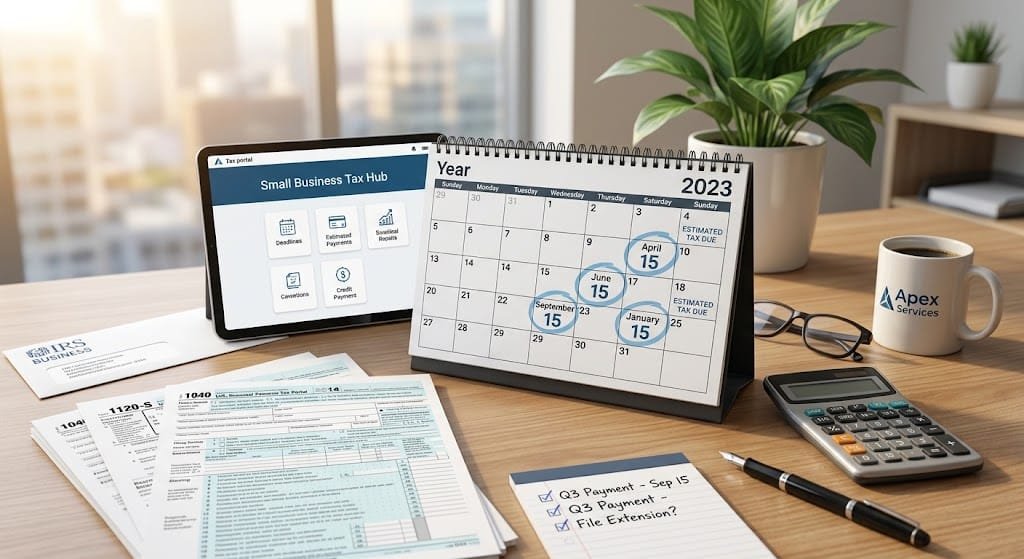
Understanding federal tax deadlines is essential for small business owners, freelancers, and sole proprietors in the United States. Staying on top of quarterly estimated payments and annual filing requirements ensures your company avoids costly IRS penalties and maintains healthy cash flow.
Proper financial preparation begins with an effective small business accounting setup, allowing you to calculate withholdings, track deductible expenses, and keep accurate records throughout the year.
This guide explains what estimated taxes are, who must pay them, official IRS quarterly due dates, annual filing requirements by business structure, and how to calculate payments using safe harbor rules. This article is general information, not legal or tax advice.
What Are Estimated Taxes (IRS Form 1040-ES)?
In the United States, taxes operate on a “pay-as-you-go” system. If you are self-employed or run a pass-through entity (such as a Sole Proprietorship, Partnership, LLC, or S-Corporation), income tax and Self-Employment tax (Social Security and Medicare) are not automatically withheld from your earnings.
To satisfy your tax liability throughout the year, the IRS requires quarterly estimated tax payments submitted with Form 1040-ES.
Who Must Pay Quarterly Estimated Taxes?
- Sole Proprietors & Freelancers: Individuals who expect to owe $1,000 or more in federal tax when filing their annual return.
- Corporations (C-Corps): Businesses that expect to owe $500 or more in federal income tax.
Official IRS Quarterly Estimated Tax Schedule
Unlike regular calendar quarters, IRS estimated tax payment periods cover varying months throughout the fiscal year:
| Quarter / Payment Period | Income Earned Period | IRS Payment Due Date |
|---|---|---|
| 1st Quarter (Q1) | January 1 – March 31 | April 15 |
| 2nd Quarter (Q2) | April 1 – May 31 | June 15 |
| 3rd Quarter (Q3) | June 1 – August 31 | September 15 |
| 4th Quarter (Q4) | September 1 – December 31 | January 15 (Following Year) |
Note: If a tax deadline falls on a weekend or federal holiday, the due date automatically shifts to the next business day.
Key Federal Tax Filing Deadlines by Business Entity
Depending on your entity structure, your annual tax return filing deadlines will vary across the tax calendar:
1. Partnerships & S-Corporations (Forms 1065 & 1120-S)
- March 15: Annual tax returns are due for Partnerships and S-Corps operating on a standard calendar year.
- Extension Deadline: September 15 (if Form 7004 is submitted by March 15).
2. Sole Proprietors & C-Corporations (Forms 1040 & 1120)
- April 15: Individual tax returns (Schedule C) and C-Corporation income tax returns are due.
- Extension Deadline: October 15 (if an extension is filed by April 15).
For official forms, publication guides, and direct payment options, small business owners should check the official IRS business tax center.
3. Payroll & Information Returns (1099-NEC & W-2)
If your business hires independent contractors or employees, you must issue tax statements by January 31:
- Form 1099-NEC: Distributed to non-employee independent contractors paid $600 or more.
- Form W-2: Distributed to employees and filed with the Social Security Administration.
If you manage an online storefront or sell digital products, reviewing an e-commerce legal and tax guide helps ensure compliance with state-level sales tax obligations alongside federal filings.
How to Calculate & Pay Estimated Taxes
To calculate estimated payments and prevent underpayment penalties, most small business owners rely on Safe Harbor Rules:
- Prior Year Safe Harbor: Pay at least 100% of the total tax shown on your prior year’s tax return (110% if your Adjusted Gross Income exceeds $150,000).
- Current Year Safe Harbor: Pay at least 90% of the total tax liability you will owe for the current tax year.
Payment Methods
Estimated payments can be submitted electronically using IRS Direct Pay, the Electronic Federal Tax Payment System (EFTPS), or via mail with a Form 1040-ES voucher.
IRS Underpayment Penalties
Failing to make quarterly payments on time—or underpaying your estimated liability—results in an IRS underpayment penalty. The penalty is calculated as an interest charge on the underpaid amount for each specific quarter.
For comprehensive regulatory guidelines on withholding rules and penalty calculations, refer to the IRS Publication 505 guide.
Best Practices for Small Business Tax Management
- Set aside tax money monthly. Reserve 25% to 30% of net income in a separate bank account for quarterly taxes.
- Track income and expenses in real-time. Regular bookkeeping prevents surprises when estimated payments are due.
- Mark payment dates on your calendar. Avoid missed deadlines by setting reminders a week before April 15, June 15, September 15, and January 15.
- Re-evaluate estimated income quarterly. If your earnings spike or drop significantly, adjust your remaining estimated payments accordingly.
- Keep thorough receipts and invoices. Documenting every business deduction reduces your taxable income legally.
Common Small Business Tax Mistakes
- Waiting until April 15 to pay all taxes. Missing quarterly estimated payments leads to avoidable penalties.
- Confusing an extension to file with an extension to pay. Filing an extension gives you more time to submit paperwork, not more time to pay owed taxes.
- Forgetting state and local tax obligations. Federal deadlines are crucial, but state income tax and sales tax rules must also be followed.
- Mixing personal and business funds. Separate bank accounts are required to maintain clean financial records.
Frequently Asked Questions
What happens if I miss a quarterly estimated tax payment?
If you miss a deadline, pay as soon as you can. The IRS calculates underpayment penalties based on how late the payment is, so paying earlier reduces the penalty fee.
What is the safe harbor rule for estimated taxes?
It is an IRS provision that protects you from underpayment penalties if you pay at least 100% of your previous year’s total tax liability (or 110% for high earners) through estimated payments.
Do newly formed small businesses have to pay estimated taxes?
If you expect to owe $1,000 or more in taxes for your first year of operation, you are required to make quarterly estimated tax payments based on projected income.
How do I know if I need to pay federal estimated taxes?
If you receive income that is not subject to automatic tax withholding—such as self-employment income, business profits, or dividends—and expect to owe $1,000 or more, you must make estimated payments.
Conclusion
Managing small business tax deadlines requires consistent tracking and timely estimated payments throughout the year. By following IRS payment schedules, utilizing safe harbor rules, and maintaining clean financial records, you can keep your business compliant and avoid unexpected penalties. This guide is general information and not formal legal, accounting, or tax advice.
Pingback: Independent Contractor vs Employee: How to Classify Workers
Pingback: Self Employment Tax for Small Business: A Simple Guide