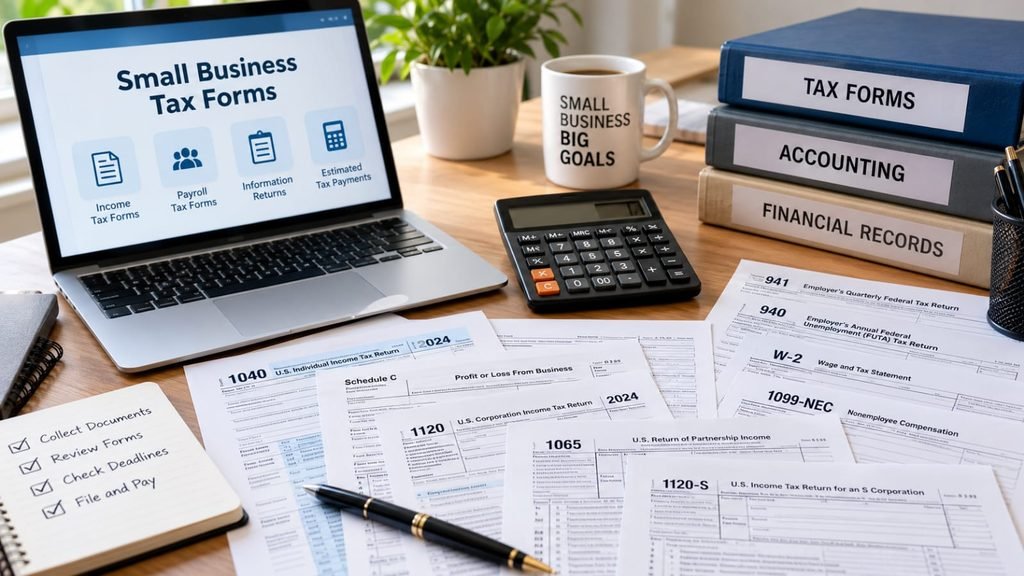
Running a small business involves more than managing customers, tracking expenses, and generating revenue. Business owners must also understand which tax forms they need to file, when those forms are due, and what financial records they should keep.
The challenge is that there is no single tax form for every small business. Your filing requirements depend on how your business is structured, how it is taxed, whether you have employees, and the types of payments you make or receive.
For example, a sole proprietor may report business income on Schedule C, while a partnership generally files Form 1065. Corporations and businesses with employees have different reporting responsibilities.
Understanding small business tax forms can help you organize your records, prepare for tax season, and avoid overlooking important filing obligations.
This guide explains the most common federal tax forms for small businesses in the United States, who may need them, and how to prepare for filing.
What Are Small Business Tax Forms?
Small business tax forms are official documents used to report business income, expenses, employment taxes, deductions, and other information to the Internal Revenue Service (IRS).
Some forms report income and calculate taxes. Others provide information about employees, independent contractors, business ownership, or estimated tax payments.
The forms you need depend on your business’s federal tax classification and activities.
For example, a business that operates without employees may have different filing obligations from a corporation that pays employees and hires independent contractors.
You should identify the forms that apply to your specific situation rather than assuming every small business must file the same documents.
Which Tax Forms Does Your Small Business Need?
The following sections explain common federal tax forms and their general purposes.
Not every business needs every form. Some forms are required only when certain conditions apply.
1. Form 1040: U.S. Individual Income Tax Return
Form 1040 is the standard federal individual income tax return.
Sole proprietors generally report their business income as part of their individual income tax return. Depending on their activities, they may attach Schedule C, Schedule SE, or other applicable schedules.
A single-member LLC that uses the default federal tax classification is generally treated as a disregarded entity for income tax purposes. Its owner typically reports the business’s income and expenses on the owner’s individual return.
However, an LLC that elects corporate tax treatment may follow different filing requirements.
Form 1040 is not the standard income tax return for a C corporation, which generally files Form 1120.
2. Schedule C: Profit or Loss From Business
Schedule C is used by many sole proprietors to report business income and deductible business expenses.
It helps determine the business’s net profit or loss for the tax year.
Common items reported on Schedule C may include:
- Gross receipts from business activities.
- Returns and allowances.
- Cost of goods sold, when applicable.
- Advertising and marketing expenses.
- Business insurance.
- Office expenses and supplies.
- Certain professional fees.
- Other eligible business expenses.
For example, suppose a freelance designer receives $80,000 in business revenue and has $25,000 in allowable business expenses.
Before considering other applicable adjustments, the business’s net profit would be $55,000.
The actual tax calculation depends on the owner’s complete tax situation and the applicable rules.
Keeping accurate bookkeeping records throughout the year makes preparing Schedule C easier.
3. Schedule SE: Self-Employment Tax
Schedule SE is used to calculate self-employment tax when required.
Self-employment tax generally covers Social Security and Medicare taxes for eligible self-employed individuals.
A sole proprietor may need to file Schedule SE when their net earnings from self-employment meet the applicable filing requirements.
For many self-employed individuals, the general threshold is $400 in net earnings from self-employment, although special rules and exceptions may apply.
Self-employment tax is different from regular federal income tax. Depending on the taxpayer’s circumstances, both may apply.
If you operate a sole proprietorship or a single-member LLC taxed as a sole proprietorship, understanding Schedule SE can help you plan for your tax obligations.
4. Form 1040-ES: Estimated Tax for Individuals
Form 1040-ES helps individuals calculate and pay estimated federal income taxes.
Self-employed business owners may need to make estimated tax payments because their business income generally does not have the same withholding arrangements as employee wages.
Estimated payments may cover both income tax and self-employment tax.
Whether you need to make estimated payments depends on your expected tax liability, withholding, credits, and other applicable rules.
Missing required payments may result in an underpayment penalty.
Business owners should review their income and expenses regularly instead of waiting until the end of the year to estimate their tax obligations.
5. Form 1065: U.S. Return of Partnership Income
Form 1065 is generally used by partnerships to report their income, deductions, gains, losses, and other tax information.
A partnership typically passes its taxable income and other tax items through to its partners rather than paying federal income tax as a separate taxable entity.
Partnerships generally provide Schedule K-1 to each partner to report that partner’s share of relevant tax items.
Partners use the information from Schedule K-1 when preparing their own tax returns.
Partnership filing requirements differ from those for sole proprietors and corporations, so businesses with multiple owners should confirm their federal tax classification before preparing their returns.
6. Form 1120: U.S. Corporation Income Tax Return
Form 1120 is generally used by domestic C corporations to report taxable income and calculate federal corporate income tax.
The form includes information about the corporation’s income, deductions, and other relevant tax items.
A C corporation is generally a separate taxpayer from its shareholders.
This means the corporation’s tax return is different from an owner’s individual tax return.
If you operate a corporation, maintain complete financial statements and supporting records throughout the year to help prepare the corporate return.
7. Form 1120-S: U.S. Income Tax Return for an S Corporation
Form 1120-S is generally used by an eligible corporation that has made a valid S corporation election.
An S corporation generally passes its income, losses, deductions, and credits through to its shareholders under applicable tax rules.
Shareholders generally receive Schedule K-1 reporting their shares of relevant tax items.
An S corporation that pays an owner for services must also consider applicable compensation and payroll requirements.
The corporation’s filing responsibilities depend on its tax status and activities.
Do not assume that an S corporation follows the same rules as a sole proprietorship simply because its income may pass through to its shareholders.
8. Form 941: Employer’s Quarterly Federal Tax Return
Form 941 is generally used by employers to report federal income tax withheld from employees’ wages and the applicable Social Security and Medicare taxes.
Businesses with employees may need to file Form 941 quarterly unless an IRS-approved exception or alternative filing arrangement applies.
Employers should maintain accurate payroll records showing wages, withholding, and applicable employment taxes.
Payroll reporting is separate from the business’s income tax return.
For example, a corporation may need to file an income tax return and separate employment tax returns.
9. Form 940: Employer’s Annual Federal Unemployment Tax Return
Form 940 is used by employers to report federal unemployment tax under the Federal Unemployment Tax Act (FUTA).
Whether a business must file Form 940 depends on applicable employer and wage requirements.
Federal unemployment tax is different from federal income tax withholding and Social Security and Medicare taxes.
Businesses with employees should review the IRS requirements to determine whether Form 940 applies to them.
10. Form W-2: Wage and Tax Statement
Form W-2 reports wages and certain taxes withheld for employees.
Employers generally must provide Form W-2 to employees and file the required copies with the Social Security Administration when applicable.
The form reports information such as wages and federal income tax withheld.
Business owners should distinguish between employees and independent contractors because the reporting requirements are different.
Worker classification depends on the actual working relationship and applicable law, not simply on the title used in a contract.
11. Form 1099-NEC: Nonemployee Compensation
Form 1099-NEC is used to report certain payments made to nonemployees for services performed in a trade or business.
Businesses may need to file this form when they pay eligible independent contractors or other service providers and the applicable reporting requirements are met.
For payments made after December 31, 2025, the general federal reporting threshold for certain Form 1099-NEC payments increased to $2,000, subject to the applicable rules and exceptions.
Different thresholds or rules may apply to other types of payments and information returns.
Before filing, check the current IRS instructions for Form 1099-NEC and confirm whether the payment and recipient fall within the reporting requirements.
Keep accurate records of contractor payments and collect the appropriate taxpayer information when required.
Small Business Tax Forms by Business Structure
The easiest way to identify potentially relevant tax forms is to begin with your business’s federal tax classification.
Sole Proprietorship
A sole proprietor may need some of the following forms, depending on the business’s activities and tax situation:
- Form 1040.
- Schedule C.
- Schedule SE.
- Form 1040-ES, when estimated payments are required.
- Employment tax forms if the business has employees.
Not every sole proprietor needs every form on this list.
Single-Member LLC
A single-member LLC is generally treated as a disregarded entity for federal income tax purposes unless it elects corporate treatment.
When the default classification applies, an individual owner generally reports business income on their individual return using the appropriate schedules.
An LLC that elects to be taxed as a corporation may have different filing obligations.
Partnership
A partnership generally files Form 1065 and provides Schedule K-1 to its partners.
Individual partners may need to report their share of partnership income and other tax items on their own returns.
A partnership may also have employment tax and information reporting obligations depending on its activities.
C Corporation
A C corporation generally files Form 1120.
If it has employees, it may also have payroll reporting obligations, including applicable employment tax returns and employee wage statements.
Additional forms may be required depending on its activities and transactions.
S Corporation
An S corporation generally files Form 1120-S and provides Schedule K-1 to its shareholders.
If it has employees, including shareholder-employees when applicable, it must also follow the relevant payroll and employment tax rules.
The corporation should confirm its filing obligations with a qualified tax professional when its circumstances are complex.
How to Determine Which Tax Forms Your Business Needs
You do not need to memorize every IRS form to manage your business’s tax responsibilities.
Instead, follow a structured process.
Step 1: Confirm Your Federal Tax Classification
Determine whether your business is treated as a sole proprietorship, partnership, C corporation, S corporation, or another classification for federal tax purposes.
An LLC’s state-law structure does not automatically determine its federal tax classification.
This first step helps establish which income tax return generally applies.
Step 2: Identify Your Business Activities
Consider whether your business:
- Has employees.
- Pays independent contractors.
- Makes payments that require information returns.
- Operates in a specialized industry.
- Has activities subject to excise taxes.
- Has foreign financial accounts or international transactions that create additional reporting obligations.
Certain activities may require forms beyond the standard income tax return.
Step 3: Review Your Financial Records
Organize the information needed to prepare your tax returns.
This may include:
- Revenue and sales records.
- Business expense receipts.
- Bank statements.
- Payroll reports.
- Contractor payment records.
- Loan and interest records.
- Inventory records.
- Prior-year tax returns.
Good bookkeeping reduces the time needed to gather information during tax season.
Step 4: Check Filing Deadlines
Different forms have different deadlines.
For example, individual income tax returns, partnership returns, corporate returns, and employment tax returns do not necessarily share the same due dates.
Some deadlines may also change because of weekends, holidays, extensions, or special IRS relief.
Check the current IRS instructions and tax calendar rather than relying on a generic list of dates.
Step 5: Verify the Current Form Instructions
Tax forms and reporting rules can change.
Use the official IRS website to find the latest form, instructions, and applicable filing requirements.
If you are uncertain about your obligations, consult a qualified tax professional.
Common Small Business Tax Filing Mistakes
Choosing the Wrong Tax Form
A business may use the wrong form if it misunderstands its federal tax classification.
For example, a partnership generally follows different income tax filing rules from a sole proprietorship.
Confirm your classification before preparing your return.
Missing Filing Deadlines
Late filing or payment may lead to penalties and interest, depending on the circumstances.
Maintain a calendar of filing deadlines and review it regularly.
Mixing Personal and Business Expenses
Combining personal and business transactions makes it harder to calculate business income and substantiate deductions.
Maintain organized records and clearly identify business-related transactions.
Forgetting Employment Tax Forms
Businesses with employees may have payroll reporting responsibilities in addition to their regular income tax returns.
Review federal employment tax requirements and maintain complete payroll records.
Reporting Contractor Payments Incorrectly
Businesses must determine whether a worker is an employee or an independent contractor based on the applicable classification rules.
They must also confirm whether payments require information reporting.
Do not rely solely on a worker’s job title or a contract label.
Using Outdated Forms or Instructions
Using an old form or relying on outdated filing thresholds can lead to errors.
Always verify the applicable form and instructions for the relevant tax year.
How Good Bookkeeping Makes Tax Filing Easier
Accurate bookkeeping is one of the most effective ways to prepare for tax season.
When your financial records are organized throughout the year, you can identify income, track eligible expenses, reconcile bank accounts, and gather supporting documents more efficiently.
A practical bookkeeping routine should include:
- Recording business transactions regularly.
- Categorizing income and expenses correctly.
- Reconciling bank and credit card accounts.
- Keeping receipts and supporting documents.
- Reviewing payroll and contractor payment records.
- Preparing financial reports periodically.
- Organizing tax documents before filing deadlines.
Accounting software can help automate parts of this process, but you still need to review your records for accuracy.
If your business has complex transactions or multiple owners, consider working with a qualified accountant or tax professional.
Frequently Asked Questions
What tax forms does a small business need?
The required forms depend on the business’s federal tax classification and activities.
A sole proprietor may use Form 1040 with Schedule C and, when required, Schedule SE. A partnership generally files Form 1065, while a C corporation generally files Form 1120 and an S corporation generally files Form 1120-S.
Businesses with employees or certain contractor payments may have additional reporting requirements.
Does every small business need Schedule C?
No. Schedule C is commonly used by sole proprietors and certain individual business owners whose LLCs use the default federal tax classification.
Partnerships and corporations generally follow different income tax filing rules.
Do small businesses need to file Form 941?
Businesses that meet the applicable employer filing requirements generally need to file Form 941 quarterly unless an IRS-approved exception or alternative filing arrangement applies.
The requirement depends on the employer’s circumstances.
What is the difference between Form W-2 and Form 1099-NEC?
Form W-2 reports wages and certain taxes withheld for employees.
Form 1099-NEC reports certain payments for nonemployee services when the applicable information reporting requirements are met.
The two forms serve different purposes and should not be used interchangeably.
Can an LLC file Schedule C?
An LLC with one individual owner is generally treated as a disregarded entity for federal income tax purposes unless it elects corporate treatment.
When that default classification applies, the owner commonly reports business income and expenses on Schedule C.
An LLC with a different federal tax classification may have different filing requirements.
Where can I find official small business tax forms?
The IRS provides official forms, instructions, and publications through its website.
Start with the IRS Small Business Forms and Publications page and select the forms relevant to your business structure and activities.
Always review the current instructions before filing.
Final Thoughts
Understanding small business tax forms can help you prepare for tax season, maintain accurate financial records, and meet your federal filing responsibilities.
The forms you need depend on your business structure, federal tax classification, employees, contractor payments, and other business activities.
Start by confirming how your business is classified, identifying your reporting obligations, and organizing your financial records throughout the year.
Then verify the current IRS forms, instructions, and deadlines before filing.
If your business has complex tax circumstances, consult a qualified tax professional who can help you determine which forms apply.
A consistent recordkeeping routine and a clear understanding of your filing obligations can make tax season more manageable and support better financial decisions throughout the year.
Pingback: IRS Audit for Small Business: How to Prepare
Pingback: Small Business Tax Recordkeeping: What to Keep