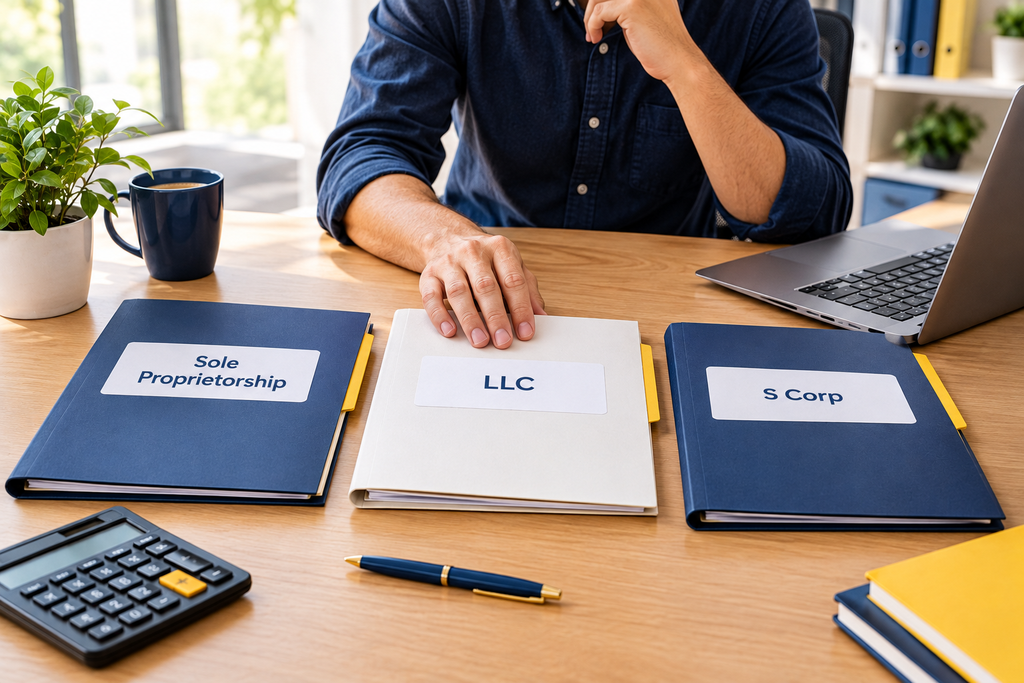
The business structure you choose affects how much you pay in taxes, how much paperwork you file, and how much of your personal property is at risk if the business runs into trouble. It also changes how you pay yourself and how you keep your books.
This guide compares the three options small business owners ask about most: the sole proprietorship, the limited liability company (LLC), and the S corporation. It explains the key differences in plain English. It does not tell you which one to pick, because the right answer depends on your situation.
The Short Version
A sole proprietorship is the simplest setup, but it offers no separation between you and the business. An LLC is a legal structure created under state law that generally protects your personal assets. An S corporation is not a separate type of business. It is a tax status that a corporation or an LLC can elect with the IRS.
What Is a Sole Proprietorship?
A sole proprietorship is an unincorporated business owned by one person. The U.S. Small Business Administration (SBA) says you are automatically considered a sole proprietor if you do business activities but do not register as any other kind of business. You do not need to file any formation paperwork to start.
- Liability: Your business assets and liabilities are not separate from your personal ones, so you can be held personally liable for the debts and obligations of the business.
- Taxes: You report business income and expenses on Schedule C, which you file with your personal tax return. The profit is taxed at individual rates, and you also owe self-employment tax on it.
- Estimated taxes: No one withholds tax from your business income, so you generally make quarterly estimated tax payments if you expect to owe.
To learn how the self-employment tax works, read our guide to self-employment tax.
What Is an LLC?
A limited liability company is a business structure allowed by state law. You form one by filing with your state, and the owners are called members. The SBA notes that an LLC generally protects your personal assets, such as your car, home, and savings, if the LLC faces a lawsuit or bankruptcy. Requirements, fees, and annual filings vary by state.
The IRS does not tax an LLC as its own category by default. How an LLC is taxed depends on its members and its elections:
- A single-member LLC is treated as a “disregarded entity.” It does not file a separate federal income tax return. The owner reports the income or loss on their own return, much like a sole proprietor.
- An LLC with two or more members is treated as a partnership by default. It files an information return, and each member reports a share of the profit or loss on a personal return.
- An LLC can elect to be taxed as a corporation instead.
Members of an LLC that is taxed as a sole proprietorship or partnership are generally considered self-employed, so they pay self-employment tax on their share of the earnings.
What Is an S Corporation?
An S corporation, or S corp, is a tax status, not a separate legal structure. A business first forms as a corporation or an LLC under state law. It then files Form 2553 with the IRS to be treated as an S corporation for federal tax purposes. The SBA points out that this is a different process from registering with your state.
- Pass-through taxes: Profits and some losses pass through to the owners’ personal tax returns. Shareholders pay tax on their share of the income whether or not it is paid out to them.
- Eligibility limits: According to the SBA, an S corp can have 100 shareholders or fewer, and the shareholders can be individuals, certain trusts, and estates. Partnerships, corporations, and nonresident aliens cannot be shareholders.
- Tax return: The business files Form 1120-S, and each shareholder receives a Schedule K-1 showing their share.
- Corporate formalities: An S corp must follow the filing and operating rules of a corporation.
- State rules: Not all states treat S corps the same way. Some tax S corps on profits above a certain limit, and a few do not recognize the election at all.
S Corp vs LLC vs Sole Proprietorship: Side-by-Side Comparison
| Feature | Sole Proprietorship | LLC | S Corp |
|---|---|---|---|
| How it starts | Automatically when you do business | State filing required | Corporation or LLC, plus Form 2553 with the IRS |
| Owners | One person | One or more people | 100 shareholders or fewer, with eligibility limits |
| Personal liability | Unlimited | Generally limited | Generally limited |
| Federal tax return | Schedule C with Form 1040 | Depends on members and elections | Form 1120-S |
| How owners are paid | Owner’s draws | Member draws or distributions | Wages through payroll, plus distributions |
| Paperwork | Least | Moderate | Most |
Ownership rules, liability, and filing requirements can vary by state, so treat this table as a general guide rather than advice for your business.
How Your Structure Changes Your Bookkeeping
Your structure affects your day-to-day accounting in a few practical ways.
- Paying yourself. A sole proprietor or LLC member usually takes owner’s draws, which are not expenses. An owner who works in an S corporation is generally paid through payroll as an employee, and any additional profit is taken as distributions. See owner’s draw vs. salary for the details.
- Payroll. An S corp owner on payroll means you have to run payroll, withhold taxes, and file the related returns. Our guide to small business payroll explains the basics.
- Separate finances. Keeping business money separate from personal money matters for every structure. The SBA says a business bank account helps protect you by keeping business and personal funds apart. Read more about opening a business bank account.
- Tax forms. Each structure files different returns. For an overview, see small business tax forms.
No matter which structure you use, accurate small business bookkeeping makes it easier to file the right returns and to see how the business is doing.
Can You Change Your Structure Later?
Yes, but it is not always simple. The SBA warns that converting to a different structure may be restricted depending on where you live, and it can lead to tax consequences and other complications. That is one reason many owners talk to an accountant or attorney before they commit. The SBA’s guide to choosing a business structure explains each option and recommends getting advice from business counselors, attorneys, and accountants.
Questions to Ask Before You Decide
- How risky is my business, and how much personal property could be exposed?
- Will I work alone, or will I have partners or investors?
- How much do I expect to earn, and how do I plan to pay myself?
- Am I ready for extra paperwork, such as annual state filings or payroll?
- What do my state’s fees and tax rules look like?
Frequently Asked Questions
Is an S corp better than an LLC?
They are not direct alternatives. An LLC is a legal structure, and an S corp is a tax status that an LLC or corporation can elect. Whether the election helps depends on your income, your state, and how you pay yourself.
Do I need an LLC to start a business?
No. If you do business activities on your own without registering another structure, you are a sole proprietor by default. Some owners start that way and move to an LLC later.
Does an LLC protect me from every lawsuit?
No. An LLC generally protects personal assets from business debts and claims, but the protection has limits. Insurance can fill gaps, and an attorney can explain how the rules work in your state.
Can a single-member LLC be taxed as an S corp?
An LLC can elect S corporation tax status by filing Form 2553 if it meets the IRS eligibility rules. Ask a tax professional whether the election makes sense for you.
Which structure needs the most bookkeeping?
An S corporation usually requires the most, because of payroll, corporate recordkeeping, and a separate business tax return. A sole proprietorship needs the least, but it still needs clear records.
Conclusion
A sole proprietorship is the simplest and offers the least protection. An LLC adds limited liability under state law. An S corporation is a tax status that can change how profits are taxed, in exchange for more rules and paperwork.
There is no single best choice for everyone. Compare liability, taxes, and the work each option adds to your books, then talk with an accountant or attorney before you decide.